
How to Measure Your Hat Size: A UK Guide for 2024

Finding a hat that doesn’t just look good but feels fantastic is an art, and it all begins with a single, crucial step: knowing your head size. An ill-fitting hat can lead to discomfort, headaches, or the constant annoyance of it slipping over your eyes. This comprehensive guide will teach you exactly how to measure your hat size, ensuring every hat you purchase from now on is a perfect fit. Whether you’re in the United Kingdom or elsewhere, these principles are universal for achieving ultimate comfort and style.
Table of Contents
- Why an Accurate Head Measurement is Crucial
- The Essential Tools for Measuring Your Head
- How to Measure Your Hat Size: A Step-by-Step Guide
- Understanding Hat Sizing Charts (UK, US & International)
- Common Mistakes to Avoid When Measuring
- Sizing Considerations for Different Hat Styles
- What to Do If You’re Between Hat Sizes
- Frequently Asked Questions
Why an Accurate Head Measurement is Crucial for Hat Comfort
You wouldn’t buy a pair of shoes without knowing your size, so why treat a hat any differently? A precise head measurement is the foundation of a comfortable and secure fit. A hat that’s too tight can cause pressure headaches and leave an unsightly red mark on your forehead. Conversely, a hat that’s too loose will constantly shift, fly off in a gust of wind, and never sit quite right, undermining the stylish look you’re aiming for.
Beyond comfort, a proper fit ensures the hat functions as intended. A well-fitted sun hat provides optimal shade, a snug beanie offers maximum warmth, and a structured fedora maintains its intended shape and angle. Investing a few moments to measure your head correctly transforms hat-wearing from a gamble into a guaranteed great experience. It’s the difference between a hat that becomes a cherished part of your wardrobe and one that gathers dust on a shelf. At Maz Accessories, we believe the perfect hat is a blend of style and comfort, which is why we stress the importance of getting your size right from the start.
The Three Pillars of a Perfect Fit
- Comfort: The most obvious benefit. A hat that fits correctly can be worn for hours without causing any discomfort, pressure points, or the need for constant readjustment.
- Style & Aesthetics: A properly sized hat sits on your head as the designer intended. This ensures the brim is angled correctly, the crown isn’t perched too high or pulled down too low, and the overall silhouette complements your features.
- Security & Functionality: Whether you’re navigating a breezy day in London or simply walking down the street, a secure fit means your hat stays put. This is especially important for functional headwear designed for sun protection or warmth.
The Essential Tools for Measuring Your Head
The good news is that you don’t need any complex or expensive equipment to determine your hat size. The process is simple, and you likely already have what you need at home. The goal is to measure the circumference of your head at the exact point where a hat would naturally rest.
The Gold Standard: The Flexible Measuring Tape
The ideal tool is a flexible tailor’s tape measure—the kind made of soft fabric or plastic. This is because it can easily conform to the shape of your head, providing the most accurate reading. Metal retractable tape measures are too rigid and will not give you a precise measurement.
DIY Alternatives: String and a Ruler
If you don’t have a flexible measuring tape, don’t worry. You can easily create a makeshift one with two common household items:
- A piece of non-stretchy string: A phone charging cable, a piece of yarn, or even a ribbon will work perfectly. The key is that it doesn’t stretch, as this would distort the measurement.
- A ruler or a rigid tape measure: Once you’ve wrapped the string around your head and marked the point where it meets, you’ll lay it flat against a ruler to determine the length in centimetres or inches.
Regardless of the tool you use, consistency and correct placement are what truly matter for an accurate result. In the next section, we’ll walk through the exact placement for a perfect measurement.
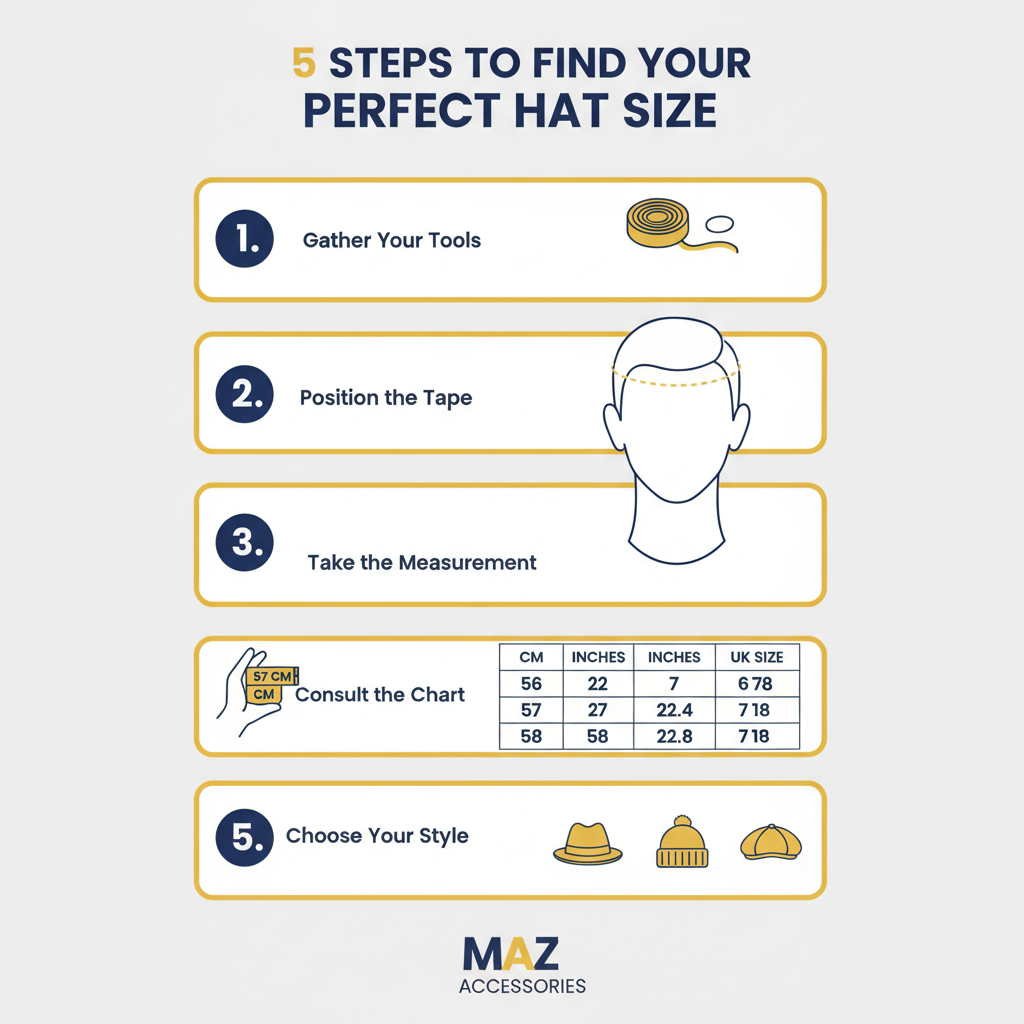
How to Measure Your Hat Size: A Step-by-Step Guide
Now that you have your tools ready, it’s time to measure. Follow these simple steps for a precise reading. For best results, ask a friend to help, but it’s certainly manageable to do on your own while looking in a mirror.
Step 1: Position the Measuring Tape Correctly
The placement of the tape is the most critical part of the process. You want to measure your head exactly where the sweatband of a hat would rest. Start by placing the end of the tape measure in the middle of your forehead, just above your eyebrows (about 1/8 inch or 0.3 cm).
Step 2: Wrap the Tape Around Your Head
Carefully wrap the tape around your head, keeping it level and straight. It should pass just above the tops of your ears (about 1/8 inch or 0.3 cm above them). The tape should go around the widest part of the back of your head. Look in a mirror to ensure the tape is not twisted and is parallel to the floor all the way around.
Step 3: Read the Measurement
Once the tape is positioned correctly and snugly wrapped, note the measurement where the end of the tape meets the rest of the tape. It’s best to take the measurement in centimetres (cm) as it is the most common unit used by hat manufacturers globally, including here in the United Kingdom. If your tape only has inches, that’s fine too – you can easily convert it later.
Step 4: Measure a Second Time
To ensure accuracy, it’s always a good idea to take the measurement two or even three times. Small variations in placement can affect the result. If you get slightly different readings, take the largest one to be safe. It’s always easier to make a slightly large hat fit better (using hat sizers) than it is to stretch a hat that’s too small.
Understanding Hat Sizing Charts (UK, US & International)
Once you have your head circumference in centimetres or inches, the next step is to translate that number into your hat size. This is where things can get a little confusing, as sizing conventions vary by country. The United Kingdom, the United States, and Europe all have their own systems. Many brands, including Maz Accessories, often provide a general S/M/L/XL sizing as well.
The most reliable measurement is always your head circumference in centimetres. However, understanding the traditional sizing systems is helpful. UK hat sizes are typically based on the diameter of the head in inches, while US sizes are slightly larger for the same number. To make it simple, we’ve created a comprehensive conversion chart below. Always refer to the specific sizing chart on the product page you’re interested in, but this table serves as an excellent general guide.
| Centimetres (cm) | Inches | UK Hat Size | US Hat Size | General Size |
|---|---|---|---|---|
| 54 | 21 1/4 | 6 5/8 | 6 3/4 | Small |
| 55 | 21 5/8 | 6 3/4 | 6 7/8 | Small |
| 56 | 22 | 6 7/8 | 7 | Medium |
| 57 | 22 1/2 | 7 | 7 1/8 | Medium |
| 58 | 22 7/8 | 7 1/8 | 7 1/4 | Large |
| 59 | 23 1/4 | 7 1/4 | 7 3/8 | Large |
| 60 | 23 5/8 | 7 3/8 | 7 1/2 | X-Large |
| 61 | 24 | 7 1/2 | 7 5/8 | X-Large |
| 62 | 24 3/8 | 7 5/8 | 7 3/4 | XX-Large |
Common Mistakes to Avoid When Measuring
Even with the right tools and steps, small errors can creep in and affect your measurement. Being aware of these common pitfalls will help you avoid them and get the most accurate size possible.
- Pulling the Tape Too Tightly: This is the most frequent error. A tape pulled too tight will compress your hair and skin, resulting in a measurement that is smaller than your actual head size. Remember the one-finger rule for a snug, comfortable fit.
- Measuring in the Wrong Location: Placing the tape too high on your forehead or too low over your ears will give you an incorrect reading. The correct path is just above the eyebrows and ears, across the most prominent part of the back of your head.
- Using a Stretchy Measuring Tool: Using an elastic band or a stretchy piece of fabric will give you an inaccurate, smaller measurement. Always use a non-stretchy string or a proper tailor’s tape.
- Not Accounting for Hair: Your hairstyle can impact your hat size. If you have very thick, curly, or voluminous hair, you might consider sizing up. If you plan to wear the hat with your hair styled in a specific way (e.g., tucked in), measure your head with your hair in that style.
- Guessing or Using an Old Measurement: Don’t assume your hat size is the same as it was a decade ago. It’s always best to take a fresh measurement before purchasing a new hat, especially from a new brand.
Sizing Considerations for Different Hat Styles
While your head measurement is a constant, the way different hat styles fit can vary. The material, construction, and intended way of wearing a hat all play a role in finding the perfect size. For a deeper dive into specific styles, you can explore our collections of men’s hats and women’s hats to see what suits you.
Fedoras, Trilbies, and other Structured Hats
For structured felt or straw hats like fedoras, trilbies, and homburgs, a precise fit is paramount. These hats have a firm shape and very little give. The internal sweatband should sit comfortably against your forehead without being tight. If you are between sizes, it is almost always better to choose the larger size. You can easily add a hat sizer (a small strip of foam or cork) under the sweatband to create a snugger fit. Trying to wear a structured hat that is too small is not only uncomfortable but can also damage the hat’s shape. The history of these classic styles, as detailed by institutions like the Victoria and Albert Museum, shows how fit was integral to their design.
Beanies and Knit Hats
Knit hats like beanies are the most forgiving when it comes to sizing. The natural stretch of the wool, acrylic, or cotton blend means they can accommodate a wider range of head sizes. Most beanies are sold as ‘one-size-fits-most’. However, if you have a particularly large head (over 61 cm) or a lot of hair, you may want to look for brands that offer specific large or extra-large sizes to avoid the beanie feeling overly tight or constantly riding up.
Flat Caps and Newsboy Caps
Popular in the United Kingdom, flat caps and newsboy caps should have a close, but not tight, fit. They are designed to sit snugly on the head. A well-fitting flat cap will stay in place without pressure. Like fedoras, these are often sold in specific numbered sizes (e.g., 57cm, 59cm), so your accurate head measurement is crucial. Some modern styles may include a small elasticated section at the back for a more flexible fit.
Baseball Caps and Snapbacks
Baseball caps offer the most adjustability. Classic ‘snapbacks’ have a plastic strap with holes, while others might have a fabric strap with a metal buckle or a velcro closure. This makes finding a fit relatively easy. However, the overall depth of the cap’s crown is also a factor. Some caps are deeper (high-profile) while others are shallower (low-profile). Your head shape, not just circumference, might make one style more comfortable than another. The concept of anthropometry, the scientific study of human body measurements, is key in designing such apparel, as explained in resources like Wikipedia’s page on the topic.
Key Takeaways
- Always use a flexible, non-stretchy measuring tape or a piece of string and a ruler for accuracy.
- Measure around your head where a hat would naturally sit: just above the eyebrows and ears.
- Ensure the tape is snug but not tight. You should be able to fit one finger underneath.
- Measure two or three times and use the largest measurement to be safe.
- Consult a sizing chart, using your measurement in centimetres as the most reliable guide.
- If you’re between sizes for a structured hat, always opt for the larger size.
- Consider the material and style of the hat, as knit beanies are more forgiving than structured felt fedoras.
What to Do If You’re Between Hat Sizes
It’s a common dilemma: your head measures 58.5 cm, but the hat you love is only available in 58 cm (Large) or 60 cm (X-Large). So, what’s the best course of action? The answer is almost always to size up.
A hat that is slightly too large is easily remedied, whereas a hat that is too small is often a lost cause. Most attempts to stretch a hat, particularly a structured one, can result in damage to the material or shape. A slightly loose hat, on the other hand, can be perfected with a simple and inexpensive accessory: the hat sizer.
Using Hat Sizers for a Custom Fit
Hat sizers are strips of foam, cork, or felt with an adhesive backing. They are designed to be placed inside the hat, underneath the sweatband. This does two things: it reduces the hat’s circumference for a snugger fit and adds extra cushioning for comfort. Here’s how to use them:
- For a small adjustment: Place one sizer at the back of the hat, under the sweatband.
- For a larger adjustment: Place one sizer at the back and another at the front. You can also place them on the sides if needed.
- Experiment: Try different placements to see what feels most comfortable and secure. You can trim the sizers with scissors for a more customized fit.
Many high-quality hats even come with a pair of sizers, but they are also widely available for purchase. They are an essential tool for any serious hat enthusiast. For more on the importance of proper fit in clothing and accessories, ergonomic studies from institutions like Cornell University’s Ergonomics Web provide fascinating insights.
Frequently Asked Questions
Is my hat size the same as my head circumference?
Not exactly. Your head circumference is the direct measurement in centimetres or inches. Your ‘hat size’ is the converted number based on a specific sizing system (e.g., UK size 7 1/8). The most important number to know is your head circumference in centimetres, as this is the most universal measurement used by hat makers.
How do I measure my head for a hat without a tape measure?
You can use any long, non-stretchy item, such as a piece of string, a ribbon, or a phone charging cable. Wrap it around your head following the same placement guidelines (above eyebrows and ears). Mark the point where the end meets the string. Then, lay the string flat against a rigid ruler to find the measurement in centimetres or inches.
Should a hat be tight or loose?
A hat should be snug, but not tight. A perfect fit means the hat sits securely on your head without causing pressure or leaving a red mark on your forehead. You should be able to fit one finger between your head and the hat’s sweatband. If you have to choose, a slightly loose hat is better as it can be adjusted with hat sizers.
Do hat sizes vary between brands?
Yes, they can. Just like clothing, sizing can vary slightly from one manufacturer to another. While a 58cm hat should be consistent, the way a brand constructs the hat or the materials used can affect the final fit. This is why it’s always best to measure your head and check the specific brand’s sizing chart before every purchase.
What is the average hat size in the United Kingdom?
The average hat size for men in the UK is around 58-59 cm (UK size 7 1/8 to 7 1/4), which corresponds to a Large. For women, the average is around 56-57 cm (UK size 6 7/8 to 7), which corresponds to a Medium. However, these are just averages, and there is a wide range of head sizes, making a personal measurement essential.
Your Perfect Fit Awaits
Mastering how to measure your hat size is a simple skill that unlocks a world of comfort and style. By taking a few moments to get an accurate measurement, you empower yourself to shop with confidence, knowing that any hat you choose will fit as if it were custom-made for you. No more headaches, no more slipping hats—just the perfect accessory to complete your look.
Now that you’re equipped with the knowledge to find your perfect size, we invite you to explore the curated collection of high-quality hats at Maz Accessories. From timeless classics to modern trends, your perfect hat is waiting. If you have any further questions, please don’t hesitate to contact our team for assistance.
